Actor's survival jobs
Many of the oldest jokes about actors are about them having other jobs – usually waiting tables. As most actors know, less than 10% of us make enough money to live. A quick Google search reveals, "To survive as a single adult in Los Angeles, you need a minimum pre-tax income of about $60,000 to cover basic necessities." Atlanta comes in at $55,000 and New York tops them at $62,000 to $70,000/year.
About 12% of union actors make enough to earn health insurance benefits (minimum earnings of $26,470/year). That means that almost all actors need to make money some other way in order to meet basic financial needs.
Recently, a longtime client of mine was shocked to learn I'd had "day jobs" for the first decade of my career. Until the pandemic, I was blessed to be part of the top percent for decades so there's an impression that I never had to hustle for money outside of our industry. The truth is that I usually had 2 part-time jobs at any given time for that first decade.
What are good jobs for actors?
The reason so many actors wait tables is that the hours are flexible and the money is immediate. As actors, we can wait months to be paid for work. How many of us have watched our work on the air while still waiting to be paid? I once took a job oversees that paid me enough to live (small) for a year, but the money had to go through multiple channels before making its way from Europe to my account. If I hadn't had credit cards, I would have had a year's worth of money coming to me while I literally went hungry. So, the first answer is – jobs that pay up front or immediately are great for actors waiting on a check.
Flexible hours were more important before self-taping. I would argue that it's easier now to take a job with 9-5 hours because you are in control of when you audition. Before the pandemic, we all had to be ready at all times to drop anything just for the chance to audition. I miss in-person auditions, but I love that we don't have to go into panic mode over scheduling conflicts or trying to cover a shift.
Subscribe to the Know Small Parts Newsletter and get Chapter 2 – Breaking Down the Scene of my book as my gift to you!
As important as flexible hours and immediate pay is – choose a job that doesn't drain you. If acting is your release when you're not at your regular job – great. But if acting is your passion, don't choose a job that makes it hard to be playful in your off-time. I've met too many actors who let their "day job" interfere with their personal goals, rather than choosing a job that supports their goals.
Pay is more than money
When I moved to Los Angeles, I didn't know anyone yet, so I went to 2-5 movies every week. The movies helped me escape, surrounded me with familiar faces, and provided me with an education in acting and filmmaking.
Someone asked if I'd been to Universal's 18-screen theatre – the largest in the world at that time. When I called the recording to get their schedule (which is how it used to work), they said they were taking applications.
The boss reading my resume wasn't sure if I was kidding. My previous employment included teaching college English and running a very successful dress boutique. He said, "You'll either quit in a week or stay for your own reasons," then hired me as an usher cleaning theaters and plunging toilets. I eventually became a ticket taker greeting customers and keeping the lobby clean.
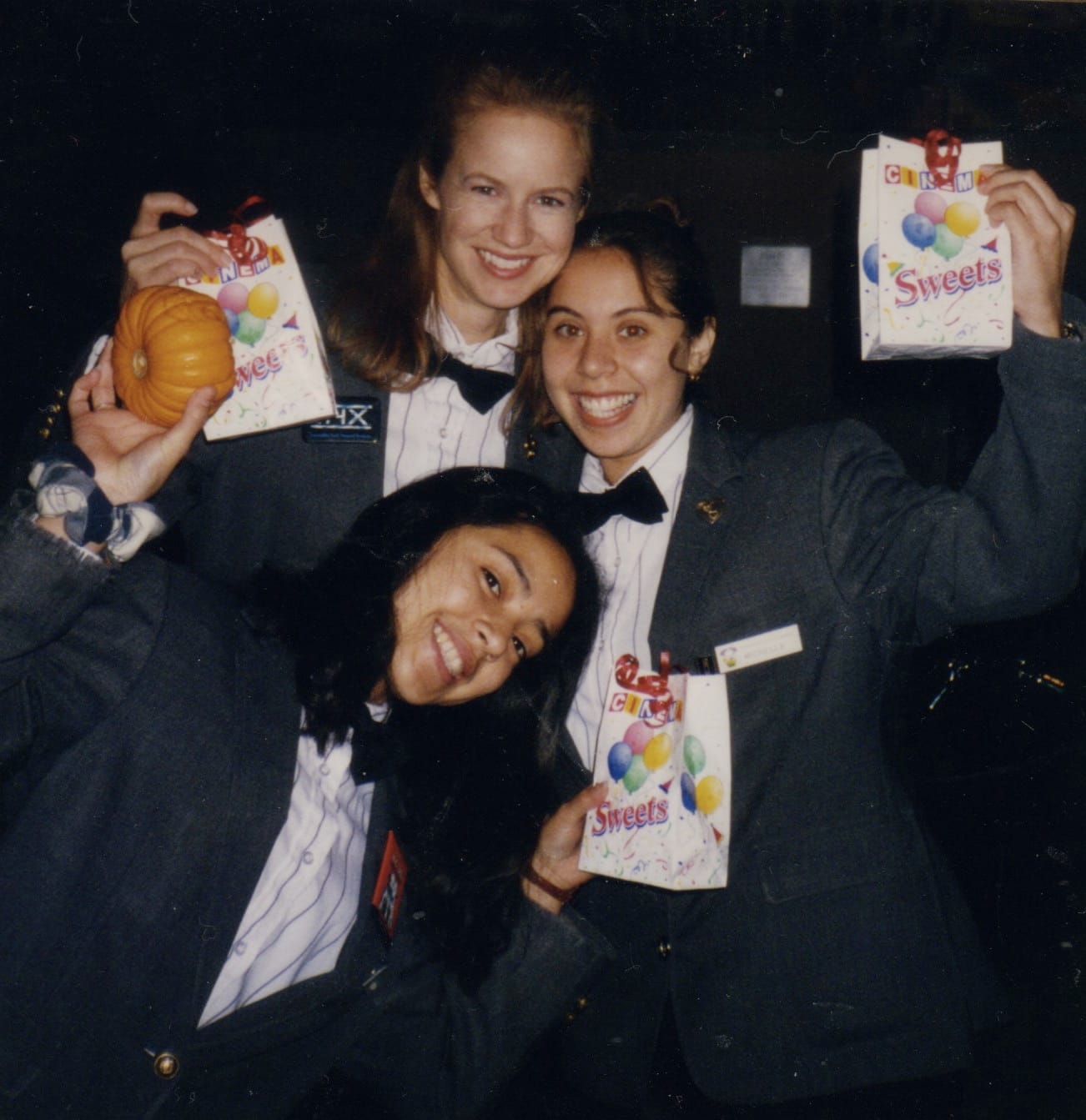
I was in my 30's working with mostly teenagers (including Aaron Paul) and was only paid about $6/hour, but I could see movies for free - saving myself a small fortune! There are more ways to measure a job's worth than just paystubs.
Once I began working more as an actor, I reduced my hours there from 3 days/week to just a 6 hour shift on Sundays. But I still got all the free movies! I can't even begin to calculate how much money I saved in tickets during the 8 years I worked there. My paychecks may been puny, but the job certainly served my goals.
During my tenure at Universal, I ended up tearing tickets to 3 movies I was in! I remember attending a premiere at the theatre one night – walking the red carpet dressed in a gown and surrounded by movie stars and photographers – then sweeping that same carpet the next day wearing a polyester suit and plastic name tag. For someone who loved movies as much as I did, both sides of my life made me happy and supported my goals.
Time is money
Time is so valuable that even money can't buy it. Use yours wisely. The idea behind getting a part-time job is that it should only take part of your time. As such, you want to find jobs that maximize earnings-per-hour. Working an hour at the theatre may have only paid about $6, but the value was much higher because of all of the money I saved on movies every week. Freebies and discounts also come with many retail jobs. People who work at a gym tend to get free membership. Part-timers at Trader Joe's may only make $14-18/hour, but they also receive a 20% discount on everything at the store, health insurance and 401(k) contributions.
Online jobs don't usually provide benefits, but many pay high hourly rates and allow you to do the work when it's convenient for you. I currently coach actors, writers and filmmakers online and appreciate being able to schedule around my own auditions, acting jobs, filmmaking, and writing.
Waiting tables, bartending, and other service jobs can be another great way to make more than wage minimums. Tips are less reliable than wages, but they can be far more generous.
Marketing your skills is another potential strategy. I mentioned having 2 part-time jobs – I was also a private tutor for the SAT's. There were no tips involved, but my skill was worth about 5-7 times the minimum wage at that time (after paying the company that hired me out!). All of the work happened after 3pm – which landed it outside prime audition hours – and I was in charge of the appointment scheduling.
Get a subscription to the Writing Unblocked Newsletter and get the Writing Unblocked ebook as my gift to you!
For several years, I worked as a reader for production companies doing coverage on scripts. I got to read movies before the actors were cast and play out the stories in my head before anyone filmed them. As long as the coverage was turned in by the deadline, I could choose my schedule and I was paid per script.
Summarizing stories and teaching were skills I had before my acting career began. I just had to find flexible jobs that valued those skills.
What does the job cost you?
Tutoring was a good job for me on many levels – not just good pay and flexible scheduling. I love teaching and have worked as a teacher in some way or another since I was in 8th grade and was given (by myself!) a classroom full of 1st graders in need of library skills. By the end of that year, I was hooked on helping people understand things.


When I would drive home from tutoring kids for the SAT's, I would usually feel good about myself and how I'd spent my time. After a day at the movie theater, I'd feel in love with movies and grateful for the crowds that would watch them.
But I've had other jobs that made me feel worse about myself and my life. I've had jobs that made me feel sick or angry or incessantly frustrated. If I have options, I'm always going to pick the job that keeps me happy or interested over the job that requires emotional recovery time – even if the pay isn't as good.
One of the most common choices I see actors make is picking their survival job over their career. If acting is just part of your life, then carry on. But if you want to make acting your career, you can't afford a job that takes more from your career than it supports. If acting is your career, then the "survival job" money is for supporting that career. Keep your bills paid. Prioritize having money for taking classes, getting headshots, updating your reel, and other career-related expenses.
When can I quit?
I quit tutoring teens for the SAT's and reading scripts when I needed the free time more than I needed the money. But I didn't quit tearing tickets at the theater until I had to cancel work for scheduling issues more often than I was able to attend my Sunday hours.
I suggest keeping a job you like for as long as you possibly can.
I suggest leaving a job that's interfering with your career as quickly as possible.
The secret to making it work
I'm not hiding this behind a paywall because the people who most need to hear it might not have money for newsletter wisdom. One of the biggest misconceptions about actors is that we're rich. If you're in the top 10%, I don't need to explain that the percentage includes everyone from Leonardo DiCaprio and Margot Robbie to people whose names you've never heard with faces you kinda recognize from something – the working actors who made at least $26,500 last year.
Subscribe to the Know Small Parts Newsletter and get Chapter 2 – Breaking Down the Scene of my book as my gift to you!
Until the pandemic pushed many of us under the health insurance minimums, I was one of those working actors in the same top percent as Tom Cruise – but making closer to that insurance minimum than Cruise's $12 million salary minimum. So how did I do it? How did I manage to go without a survival job living in Los Angeles without making big bucks?
I chose my career over almost everything.
I would rather rent half of a modest duplex than owe money for a mansion. I would rather drive a used car than owe a monthly car note. I made choices over and over to live within my means. As long as my bills were paid, I could focus on acting. And I could afford to say no to parts I didn't want – which felt empowering. Those feelings were worth more to me than designer labels and the latest phone.
The less I spend, the less I need to make – and the more freedom I have to focus on the things I truly care about.
Freedom is priceless. My acting career has cost me many things. I've missed weddings, funerals, and big chunks of "normal life," but I've been on a big adventure for over 30 years and I'm still not sure where it's taking me. Wherever it leads, it will be a result of the choices I've made to focus on the acting instead of the jobs I took to support my career.
Ask me!
I invite you to send me your questions. I select some of these questions for future newsletter topics.
Thanks for reading! I hope this inspired you to dare to live your calling.
Please consider becoming a paid subscriber. I love writing for you, and your support ensures I can keep sharing my time and information.
Comments ()